Nuggets from Buffett – Part one

I recently had an opportunity to read “Essays of Warren Buffett“. Below are some of the key short takeaways (for me). For a more thorough perspective on each of these I would highly recommend the book.

On Corporate Governance

More Money, It has been noted, has been stolen with the point of a Pen than at the point of a gun

Managers that always promise to “Make the Numbers” will at some point be tempted to “Make up” the Numbers

At too many companies, the boss shoots the arrow of managerial performance and then hastily paints the Bulls-eye around the spot where it lands

Good Managerial record is far more a function of what business boat you get into than it is of how effectively you row (though intelligence and effort help considerably, of course, in any business good or bad). Should you find yourself in a chronically leaking boat, energy devoted to changing vessels is likely to be more productive than energy devoted to patching leaks.

There is plenty of money to be made at the center of the court. If it’s questionable whether some actions are close to the line, just assume it is outside and forget it.

On finance and Investing

Final Exam: If you expect to be a net saver during the next five years, should you hope for a higher or lower stock market during that period? Many Investors get this one wrong, Even though they are going to be net buyers of stock for years to come, they are elated when stock prices rise and depressed when they fall. In effect they rejoice because prices have risen for the “Hamburgers” they will soon be buying. This reaction makes no sense, only those who are sellers of equities in the near future should be happy at seeing stocks rise. Prospective purchasers should much prefer sinking prices.

Our goal is to find an outstanding business at a sensible price, not a mediocre business at a bargain price

Lack of capital allocation skills is very high, Most bosses rise to the top because they have excelled in an area such as Marketing, Production, Engineering, administration – or sometimes, institutional politics.

Leaving the question of price aside, the best business to own is one that over an extended period can employ large amounts of incremental capital at very high rate of return. The worst business does the opposite — that is consistently employs ever greater amounts of capital at very low rate of return. unfortunately the first type of business of is very hard to find;

In a difficult business, no sooner is one problem solved than another surfaces – never is there just one cockroach in the kitchen


This is Part one since i have been able to cover only first 2 chapters …  Don’t expect part two anytime soon  🙂 

On a more serious note, Lawrence A Cunningham has done a commendable job in compiling a lifetime of wisdom to 300 pages.

Tricks of the trade

Tricks-2

"Some people are so busy learning the tricks of the trade that 
they never learn the trade" - Vernon Law

This aptly describes today’s IT industry. The extent of competition and the increasing need to learn new tools and technologies just to stay in the game, has resulted in this phenomenon

The need for speed, means that we are in a hurry to learn the tricks that will enable us to talk our way to the top. yes seriously there are best selling book that teaches just that.

This has a detrimental effect both for the industry and the individuals. The industry will leave you behind, if you do not learn the tricks quickly and use them. You never get a chance to master any subject or tool.

The Industry get quickly filled up with folks who only know the glossary of terms. As a result, their effectiveness suffers. Organizations make grand plans to grow, but are are unable to execute them effectively due to lack of depth of ability.

Quality of the deliverable suffers … but who cares we are agile, we will address it in next sprint … 🙂

Image Courtesy – web


2.0 + CMMI Reloaded

With the advent of Agile & LEAN Thinking, i have earlier lamented about the Value CMMI added to organizations. It was my opinion that unless there is complete overhaul they would soon be history See CMMI has outlived its purpose

Thankfully, I was wrong, With CMMI 2.0 The Model itself has undergone significant improvements. Its own Capability & Maturity has substantially leapfrogged.

The Practice Areas (earlier process areas) are now grouped under Capability Areas, which fall under four broad categories of Doing, Managing, Enabling and Improving

Also CMMI 2.0 integrates the Development / Services / Acquisition into a common Model, (+ Relevant PCMM aspects) with option to select relevant Practice Areas based on Organization Context

There is an additional focus now on Org. maturity through the Introduction of Capability Areas, “Managing Business Resilience” and “Sustaining Habit and Persistence” which encompasses practice areas such as Governance, Implementation Infrastructure and “Risk and Opportunity Management”

The Practice area definitions also have an Intent & value statement, which provide clarity to the stakeholders to tailor the model based on org. context.

We earlier had a the concept of Capability Level & Maturity Level and Staged and continuous representation, which had its share of confusion. This seems to have been resolved, we do not anymore have Process areas associated with levels.

Every Practice Area has Practices starting at Level 1. They have practices defined which follow an increasing level of maturity from Level 1 to 5. This also significantly improves the Assessment process and Organizations can self assess their current performance level based on the extent to which each of the practices are institutionalized.

More of it later, as i get an opportunity to deep dive into it. But for now its suffice to say, that CMMI is still very much in the game

(Do visit the CMMI Institute website for more information & Resources)

1% Better everyday

James-Clear-1-Percent-Better
The Power of Compounding

James Clear in Atomic Habits,  Writes …

Here’s how the math works out: if you can get 1 percent better each day for one year, you’ll end up thirty-seven times better by the time you’re done. Conversely, if you get 1 percent worse each day for one year, you’ll decline nearly down to zero. What starts as a small win or a minor setback accumulates into something much more.

Habits are the compound interest of self-improvement. The same way that money multiplies through compound interest, the effects of your habits multiply as you repeat them. They seem to make little difference on any given day and yet the impact they deliver over the months and years can be enormous. It is only when looking back two, five, or perhaps ten years later that the value of good habits and the cost of bad ones becomes strikingly apparent.

Process of learning

Excerpts from The Analysis of Mind by Bertrand Russell

The process of learning, which consists in the acquisition of habits, has been much studied in various animals.* For example: you put a hungry animal, say a cat, in a cage which has a door that can be opened by lifting a latch; outside the cage you put food. The cat at first dashes all round the cage, making frantic efforts to force a way out. At last, by accident, the latch is lifted. and the cat pounces on the food. Next day you repeat the experiment, and you find that the cat gets out much more quickly than the first time, although it still makes some random movements. The third day it gets out still more quickly, and before long it goes straight to the latch and lifts it at once. Or you make a model of the Hampton Court maze, and put a rat in the middle, assaulted by the smell of food on the outside. The rat starts running down the passages, and is constantly stopped by blind alleys, but at last, by persistent attempts, it gets out. You repeat this experiment day after day; you measure the time taken by the rat in reaching the food; you find that the time rapidly diminishes, and that after a while the rat ceases to make any wrong turnings. It is by essentially similar processes that we learn speaking, writing, mathematics, or the government of an empire.

Butterfly Effect

In Farnam Street, one of my favorite blogs there is a comprehensive description of Butterfly Effect  the-butterfly-effect 

Below is a brief Extract of the last section of the same, which cites a few examples & Concludes 

Many examples exist of instances where a tiny detail led to a dramatic change. In each case, the world we live in could be different if the situation had been reversed. Here are some examples of how the butterfly effect has shaped our lives.

  • The bombing of Nagasaki. The US initially intended to bomb the Japanese city of Kuroko, with the munitions factory as a target. On the day the US planned to attack, cloudy weather conditions prevented the factory from being seen by military personnel as they flew overhead. The airplane passed over the city three times before the pilots gave up. Locals huddled in shelters heard the hum of the airplane preparing to drop the nuclear bomb and prepared for their destruction. Except Kuroko was never bombed. Military personnel decided on Nagasaki as the target due to improved visibility. The implications of that split-second decision were monumental. We cannot even begin to comprehend how different history might have been if that day had not been cloudy. Kuroko is sometimes referred to as the luckiest city in Japan, and those who lived there during the war are still shaken by the near miss.
  • The Academy of Fine Arts in Vienna rejecting Adolf Hitler’s application, twice. In the early 1900s, a young Hitler applied for art school and was rejected, possibly by a Jewish professor. By his own estimation and that of scholars, this rejection went on to shape his metamorphosis from a bohemian aspiring artist into the human manifestation of evil. We can only speculate as to how history would have been different. But it is safe to assume that a great deal of tragedy could have been avoided if Hitler had applied himself to watercolors, not to genocide.
  • The assassination of Archduke Franz Ferdinand. A little-known fact about the event considered to be the catalyst for both world wars is that it almost didn’t happen. On the 28th of June, 1914, a teenage Bosnian-Serb named Gavrilo Princip went to Sarajevo with two other nationalists in order to assassinate the Archduke. The initial assassination attempt failed; a bomb or grenade exploded beneath the car behind the Archduke’s and wounded its occupants. The route was supposed to have been changed after that, but the Archduke’s driver didn’t get the message. Had he actually taken the alternate route, Princip would not have been on the same street as the car and would not have had the chance to shoot the Archduke and his wife that day. Were it not for a failure of communication, both world wars might never have happened.
  • The Chernobyl disaster. In 1986, a test at the Chernobyl nuclear plant went awry and released 400 times the radiation produced by the bombing of Hiroshima. One hundred fifteen thousand people were evacuated from the area, with many deaths and birth defects resulting from the radiation. Even today, some areas remain too dangerous to visit. However, it could have been much worse. After the initial explosion, three plant workers volunteered to turn off the underwater valves to prevent a second explosion. It has long been believed that the trio died as a result, although there is now some evidence this may not have been the case. Regardless, diving into a dark basement flooded with radioactive water was a heroic act. Had they failed to turn off the valve, half of Europe would have been destroyed and rendered uninhabitable for half a million years. Russia, Ukraine, and Kiev also would have become unfit for human habitation. Whether they lived or not, the three men—Alexei Ananenko, Valeri Bezpalov and Boris Baranov—stilled the wings of a deadly butterfly. Indeed, the entire Chernobyl disaster was the result of poor design and the ineptitude of staff. The long-term result (in addition to the impact on residents of the area) was a widespread anxiety towards nuclear plants and bias against nuclear power, leading to a preference for fossil fuels. Some people have speculated that Chernobyl is responsible for the acceleration of global warming, as countries became unduly slow to adopt nuclear power.
  • The Cuban Missile Crisis. We all may owe our lives to a single Russian Navy officer named Vasili Arkhipov, who has been called “the man who saved the world.” During the Cuban Missile Crisis, Arkhipov was stationed on a nuclear-armed submarine near Cuba. American aircraft and ships began using depth charges to signal the submarine that it should surface so it could be identified. With the submarine submerged too deep to monitor radio signals, the crew had no idea what was going on in the world above. The captain, Savitsky, decided the signal meant that war had broken out and he prepared to launch a nuclear torpedo. Everyone agreed with him—except Arkhipov. Had the torpedo launched, nuclear clouds would have hit Moscow, London, East Anglia and Germany, before wiping out half of the British population. The result could have been a worldwide nuclear holocaust, as countries retaliated and the conflict spread. Yet within an overheated underwater room, Arkhipov exercised his veto power and prevented a launch. Without the courage of one man, our world could be unimaginably different.

From these handful of examples, it is clear how fragile the world is, and how dire the effects of tiny events can be on starting conditions.

We like to think we can predict the future and exercise a degree of control over powerful systems such as the weather and the economy. Yet the butterfly effect shows that we cannot. The systems around us are chaotic and entropic, prone to sudden change. For some kinds of systems, we can try to create favorable starting conditions and be mindful of the kinds of catalysts that might act on those conditions – but that’s as far as our power extends. If we think that we can identify every catalyst and control or predict outcomes, we are only setting ourselves up for a fall.

7 Critical Thinking skills

[Found this among my notes … will update source link]

  1. Dynamic Thinking
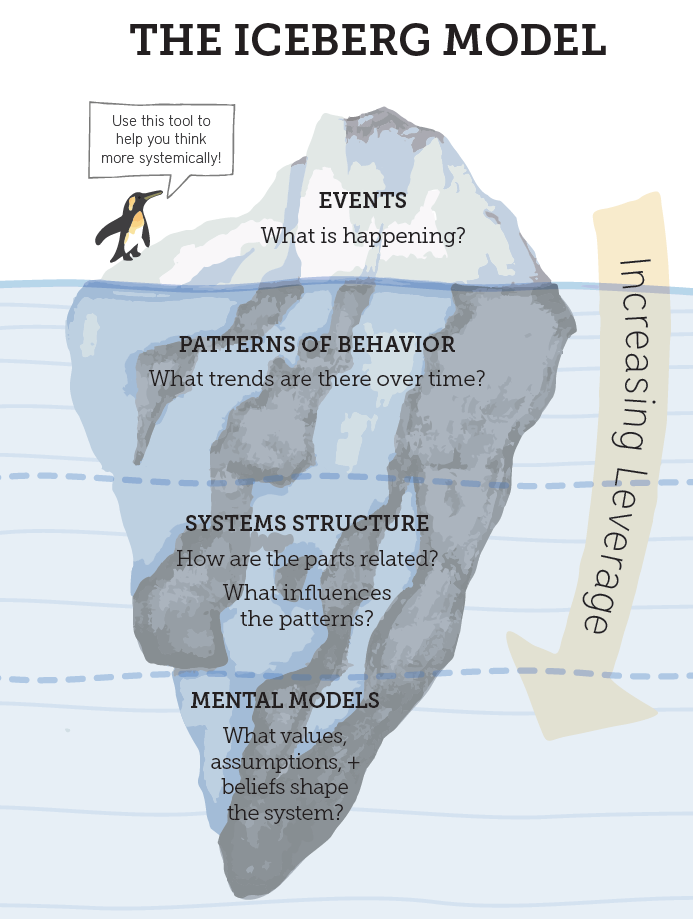
    1. Patterns of Behavior over time
    2. What happens to key variables over time
  2. System as a Cause
    1. How the Behavior arises and ways to improve behavior
    2. How could we have been responsible (Internal focus)
  3. Forest Thinking
    1. Practice focus on similarities than differences
  4. Operational thinking
    1. How is behavior actually generated
    2. List of factors that influence or drive results
    3. What is the nature of the processes
  5. Closed Loop thinking
    1. Effects feedback to influence one or more factors (Causes) and the Causes themselves affect each other
    2. Driven Drives & Drivers drive each other
    3. How dominance of variables shift over time
  6. Quantitative thinking
    1. You can always quantify (Though not measurable)
  7. Scientific thinking
    1. Disregard falsehood & Identify high leverage intervention points (Using Logic / Analytics)

Understanding Variation

Donald  J Wheeler, provides a concise summary of the key elements of Process variation in his book “Understanding Variation“. He has also included a summary of the contents presented as “Lessons” along with the Appendix

Below are some of the Key concepts of importance

DATA PRESENTATION
– Data should always be presented in such a way that preserves the evidence in the data, for all the predictions that may be made from the data

– whenever an average range or histogram is used to summarize data, the summary should not mislead the user into taking action, that the user would not take if the same is presented in a time series.

DATA INTERPRETATION

1. No data has meaning apart from their context

2. No matter how the data is presented, one should consistently use the same analysis methods for interpreting data

3. Flawed Assumptions & Flawed presuppositions, can result in flawed interpretations.

when people are pressurized to meet a target value, there are three ways they can proceed
1) They can work to improve the system
2) They can distort the system
3) or they can distort the data

PROCESS VARIATION

Predictions and specifications should not be taken as targets.A predictable process displays routine variation. An Unpredictable process displays both routine and exceptional variation. The Specification approach and the average value approach attempts to attach a meaning to each and every value. The Process behavior chart, concentrates upon the behavior of the underlying process.

Two mistakes in analyzing the data
1. Interpreting noise ( routine variation) as if it were a signal
2. Failing to detect a signal when it is present

Every potential data analysis begins by separating the potential signal from probable noise. While every data set contains noise, some data set may contain signal, therefore before you can detect a signal within every data-set, you must first filter out the noise

IN CONCLUSION

Before you can improve the system, you must listen to the voice of the system (voice of the process) then you must understand how the inputs affect the output of the system, Finally you must be able to change the inputs (and possibly the system) in order to achieve the desired results.

The Best Analysis is the simplest analysis, which provides the needed insight

Results …

Results… are the outcome of a process.

What we want are good results from a controlled process because they will be consistent & repeatable.
Bad results from an uncontrolled process simply mean that we’re not doing our job.
Good results from an uncontrolled process…only mean we’re lucky.
A bad result from a controlled process just says that we’re stupid:

We expect different results from doing the same things over and over again.